
Testing
The same tests the pros take.
A Baseline Assessment takes your athlete through four VALD systems in about 45 minutes with a coach, and ends with a report that shows where they stand and where to work. Every test is non-invasive and movement-based: they jump, land, balance, push, and sprint.
The Baseline
Same tests. Same order. Every time.
Every Baseline runs the same tests in the same order with the same number of tries, so this session compares with the next. There are no age charts and no percentiles: your athlete is compared with their own body, left side against right, and with their last session. Athletes under 12 run a shorter set of about 22 minutes.
- Overhead and single-leg squatMovement
- Countermovement and squat jumpPower
- 10-5 hop and single-leg jumpReactive strength
- Single-leg balanceBalance
- Push-up testUpper body
- Hip and hamstring strengthStrength
- 20-yard sprintSpeed
The hardware
Four systems.
Together they build a complete picture of your athlete. Here is what each one measures, and why that number matters in their sport.
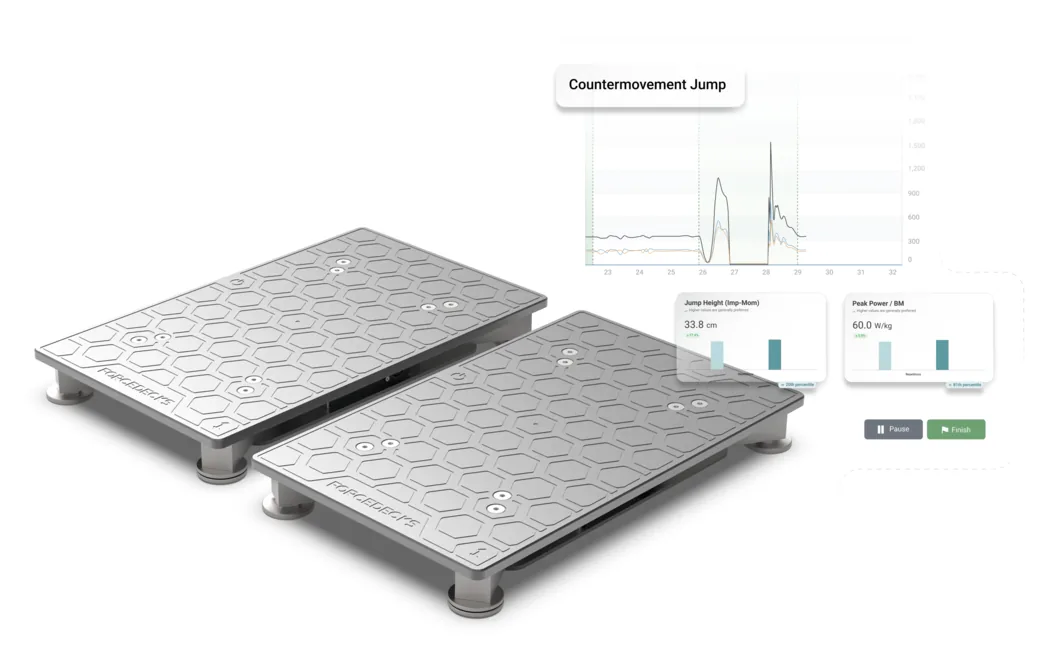
VALD ForceDecks: Force Plates
Your athlete stands on two plates and jumps, lands, or holds a position. The plates read the force of every millisecond through each leg separately. The jumps, the single-leg balance, and the push-up test run here. The hop and single-leg jump come after a two-minute landing check with the coach.
- Jump heightcm
- Peak forceN
- Power outputW/kg
- L/R asymmetry%
- Reactive strength indexRSI
- Balance sway speedmm/s
Why it matters: jump height tracks explosiveness, and because each leg is read on its own, a left-right difference that holds up across tries shows up while it is still easy to train.
VALD HumanTrak: Motion Capture
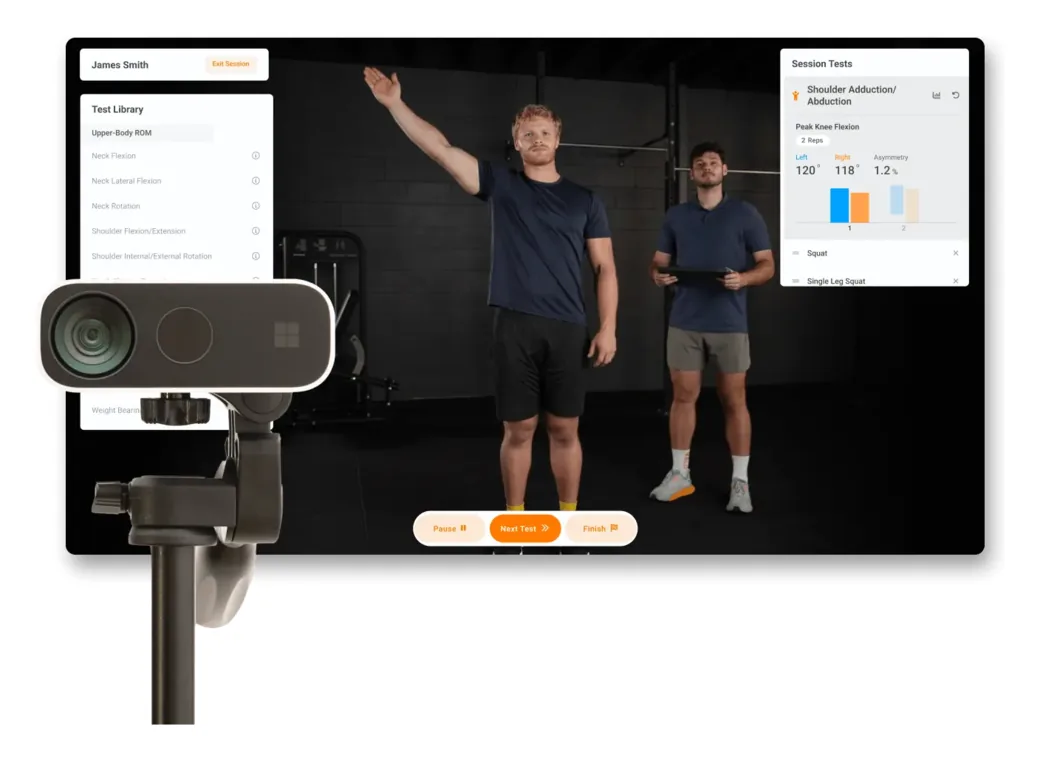
A camera-based system tracks their joints in 3D while they squat on two legs and on one. No suit, no markers. The overhead squat and single-leg squat show depth, ankle mobility, and how the knees and trunk hold up.
- Joint anglesdeg
- Squat depthcm
- Knee valgusdeg
- Trunk leandeg
Why it matters: how an athlete moves decides how they hold up. Movement quality is the difference between training hard and training safely.
VALD ForceFrame: Strength Testing
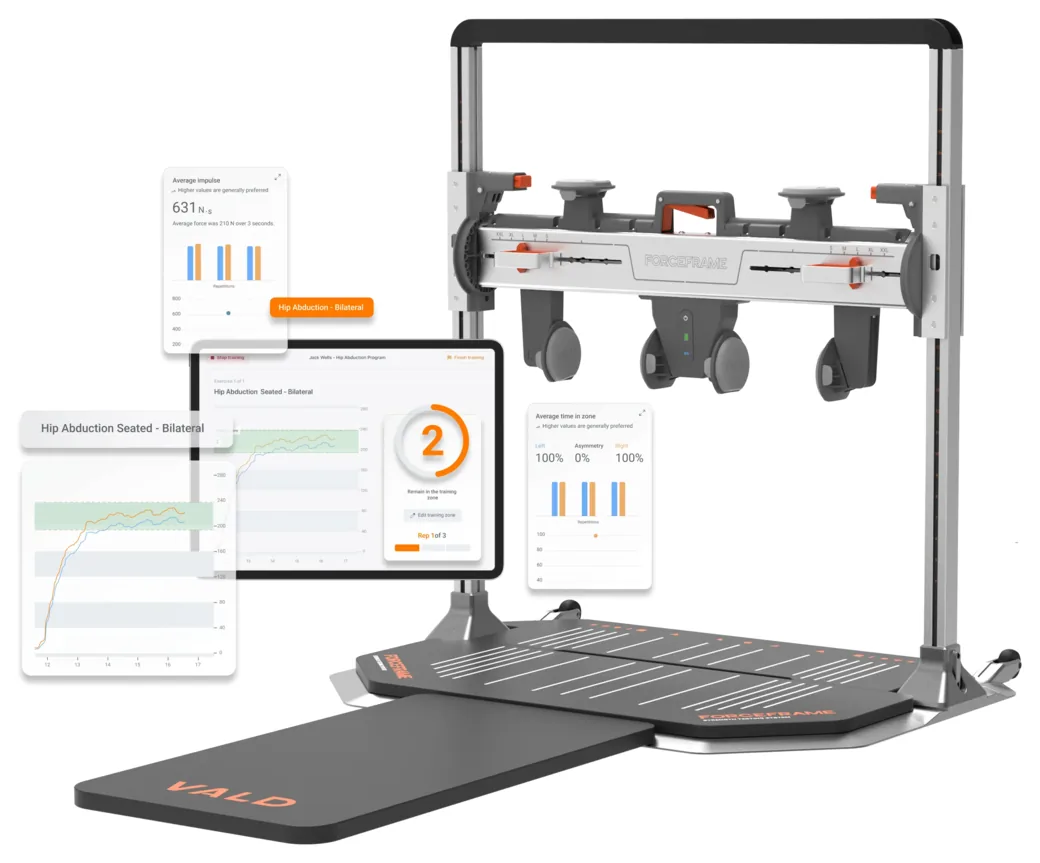
Your athlete pushes or pulls against fixed sensors, one side at a time. The Baseline measures the inner and outer hip and the hamstrings on each leg; the Overhead add-on adds the shoulder.
- Max isometric forceN
- L/R imbalance%
- Strength vs. bodyweightN/kg
Why it matters: a side-to-side gap is invisible in the mirror but clear to the sensors, and once it shows up across repeat tries, training can close it.
VALD SmartSpeed: Timing Gates
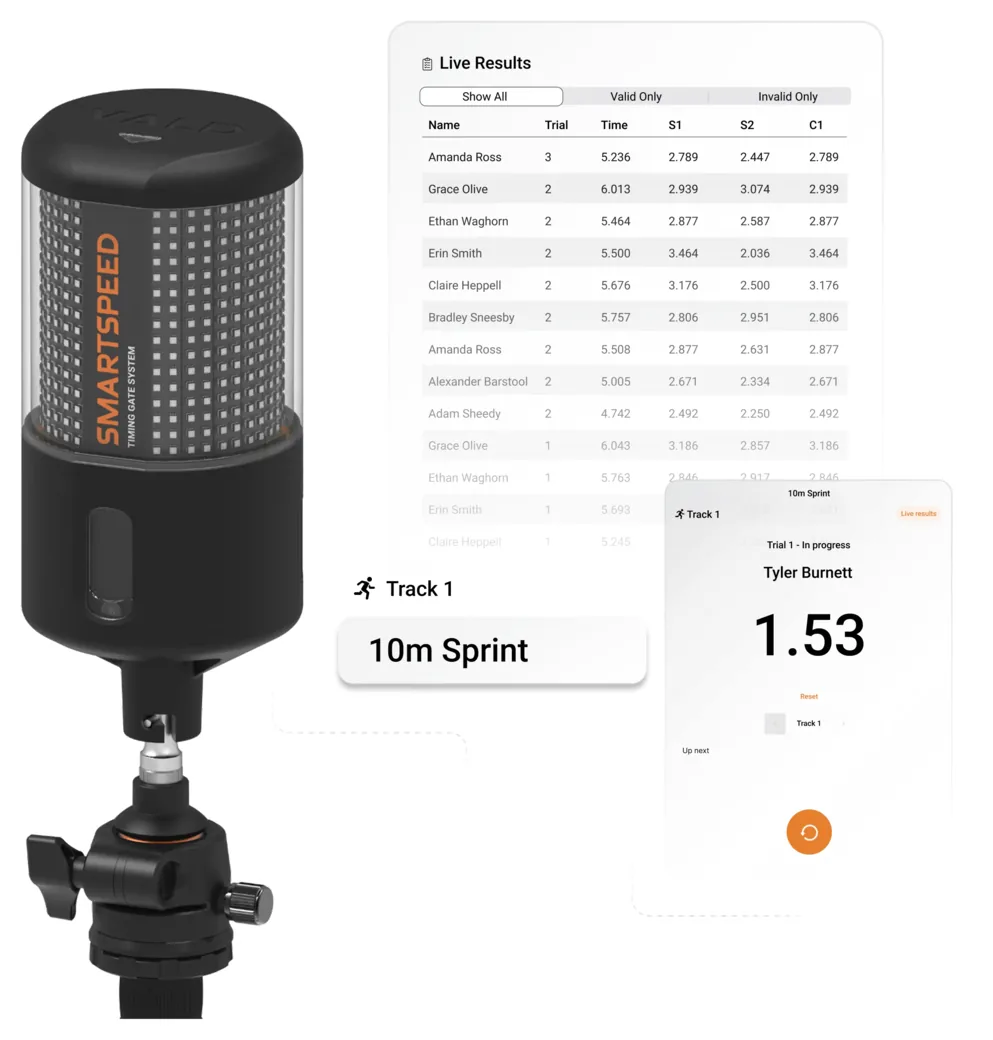
Electronic timing gates clock sprints, splits, and agility runs to the millisecond, the way combines and pro trials do it. The 20-yard sprint, with a 10-yard split, tracks speed from one test to the next.
- Sprint splitss
- Acceleration 0–10 yds
- Change of directions
Why it matters: a stopwatch hides a tenth of a second. At game speed, a tenth of a second is the play.
Sport add-ons
Fifteen more minutes for your sport.
A sport add-on puts sport-specific tests on top of any Baseline or retest, and its results get their own section of the report. Pick the one that matches how your athlete plays. $49.
Cutting Sports
Soccer, lacrosse, basketball, football. Change of direction and how the knees and hips hold up when you plant and cut.
Overhead Sports
Baseball, softball, volleyball, swimming. Shoulder rotation strength and range on each side, read knowing the throwing or hitting arm is meant to be stronger.
Jump and Landing
Basketball, volleyball, cheer, gymnastics. Drop jumps, single-leg jumps and landings, and a single-leg hop for distance, once the landing check is passed.
Speed
Track, football skill positions, soccer. The forty, with splits, and the acceleration mechanics behind it.
The report
What you walk out with.
Every Baseline and retest ends with a private report, written for the athlete and the parent, not for a sports scientist. It compares your athlete with their own body and their own last session, never with a chart of other kids, and a coach reads it before it is released.
Every test, and which numbers held up across repeat tries. A number that did not is marked for a retest, not read.
Side-to-side differences on the jumps and the strength frame, counted only when they are bigger than the spread between tries.
Up to three findings, most important first, each with a training focus. When nothing stands out yet, the report says so and sets the baseline.
When to come back and what to repeat, so the next report shows what changed.
The short version, with the training focus for each finding, ready for the floor.
After the Baseline
Then keep measuring.
A Baseline is the start. The numbers matter most when the next set shows what changed. See plans and pricing ↗
Retest
The same tests, with a new report that shows what moved. We recommend one every 6 weeks. $149, or a Season Pass: three tests with sport add-ons at the beginning, middle, and end of your season, $449 up front.
Weekly jump check
A quick force-plate jump each week between retests, included with every training plan, so the coach sees the trend before the next full test.
School and Club Testing
Bring the whole roster. $99 per athlete from 10 athletes, or $89 per athlete for schools and clubs of 30 or more. Every athlete gets the full Baseline plus tests for their sport and their own private report. There is no team ranking. A team test counts as the athlete's Baseline. Talk to us about your team.
What to expect
Show up. Move. Get the numbers.
Nothing invasive, nothing your athlete hasn't done in a warm-up. A coach runs the whole session, explains each test before they do it, and the report follows.
Then see how those numbers become training. How training works ↗
- Ages8 and up, every sport
- TimeAbout 45 minutes
- Price$199 · No sign-up fee
- WearAthletic clothes and training shoes
- BringWater. Everything else is on site
- Under 18A parent or guardian signs up
- AdultsSame Baseline, same report
Get started
It starts with a Baseline.
Baseline Assessment $199 · Retest $149 · No sign-up fees
Leave your email and a coach will email you to schedule. Or call (858) 899-0098.
Something went wrong. Try again.
Got it. A coach will email you to schedule.